
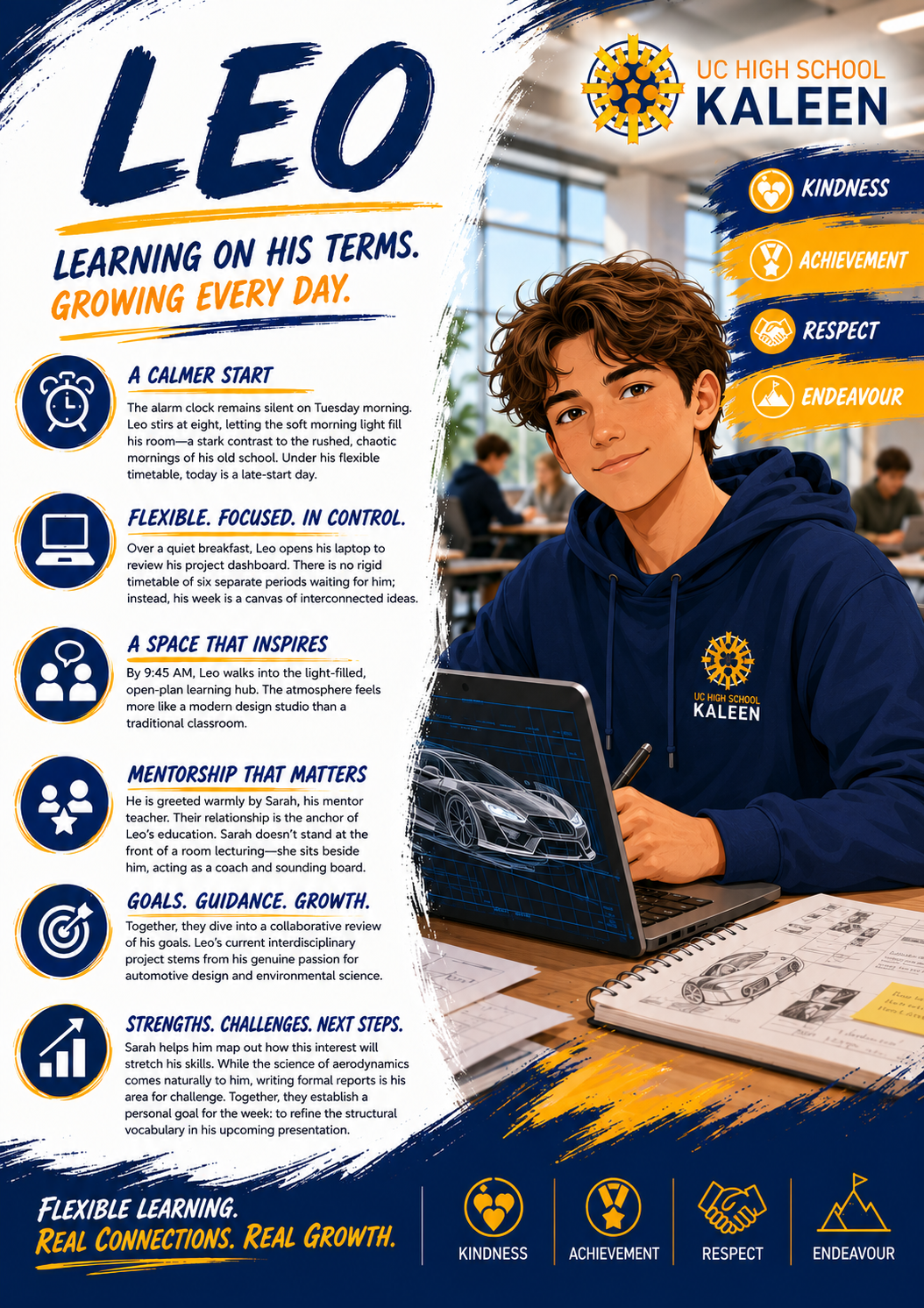
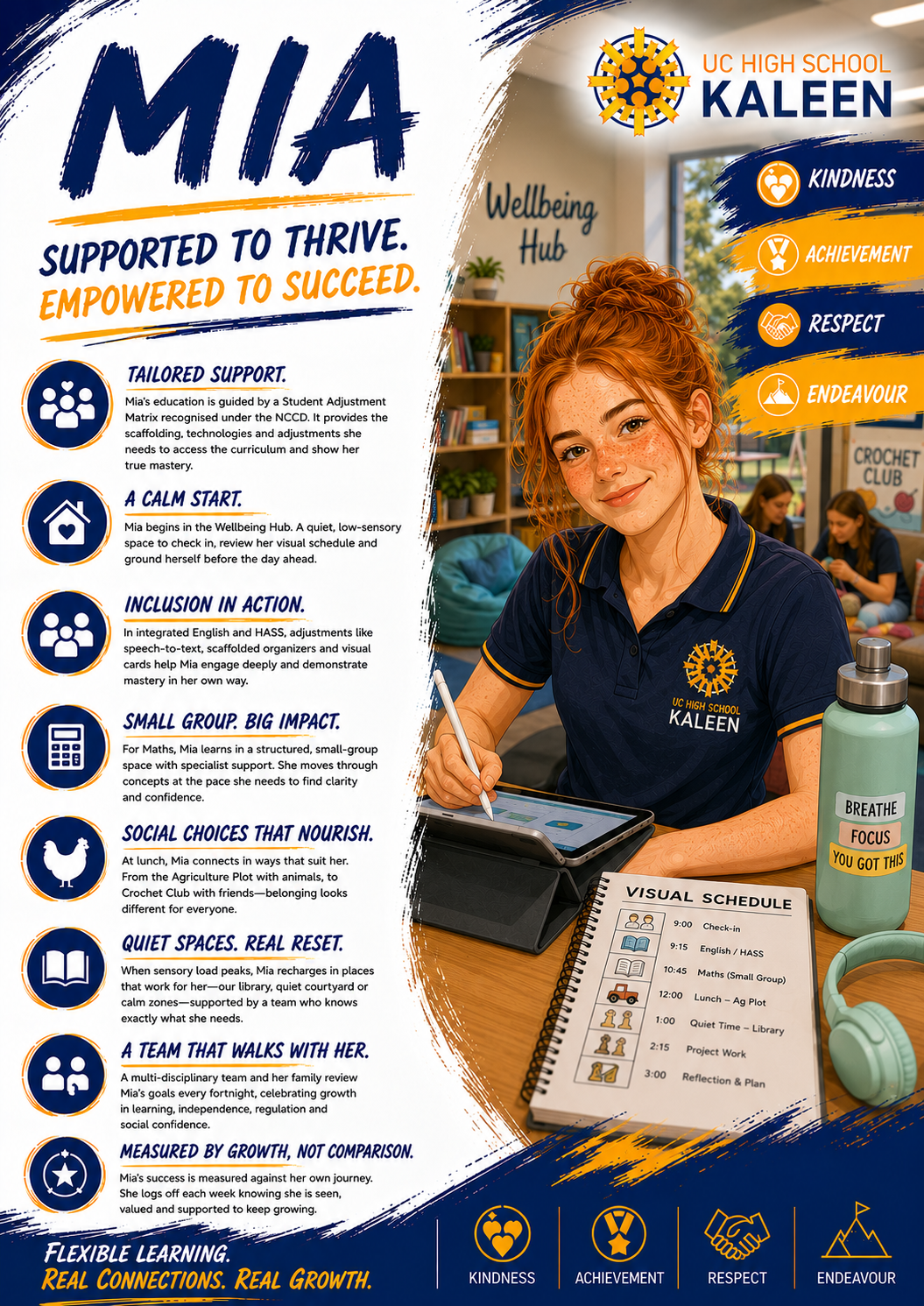
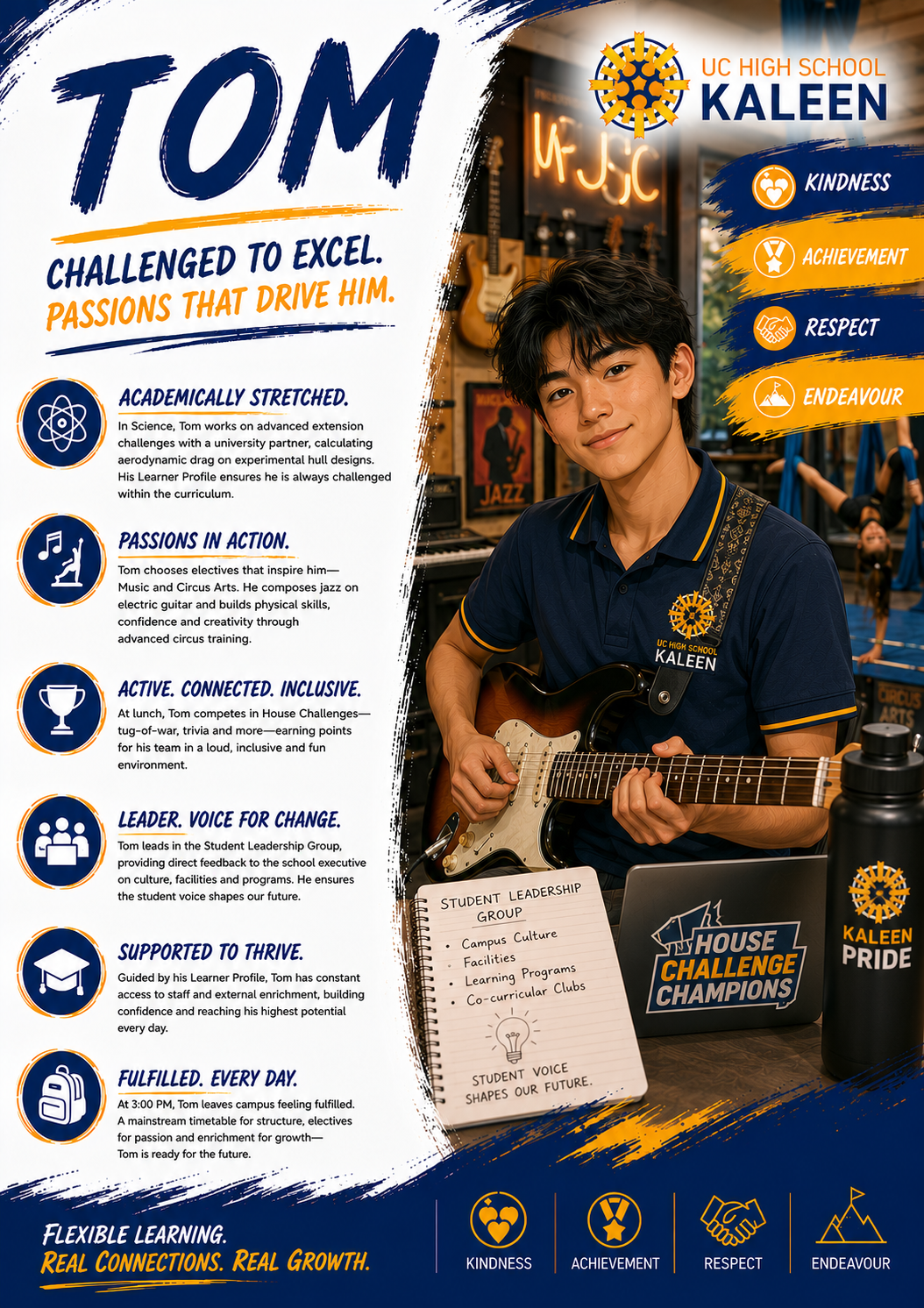
Meet Leo, Mia and Tom
Leo, Mia and Tom are more than student avatars, they represent the learners at the centre of everything we do at UCHSK. They remind us that our students are our clients, and no two arrive with the same strengths, needs, interests, experiences or aspirations. Staff need to know Leo, Mia and Tom because their stories challenge us to consider how every decision about curriculum, assessment, pedagogy, wellbeing and learning environments impacts the individual learner. They demonstrate that meeting students at their point of need does not mean creating one pathway for everyone; it means creating multiple pathways to success, from personalised and flexible learning, to intentional adjustments and support, to extension and enrichment. When we design learning with Leo, Mia and Tom in mind, we are asking a powerful question: “Can every student see a way into this learning, experience appropriate challenge, and have a meaningful way to demonstrate what they know and can do?” This is the UCHSK commitment to knowing our learners, removing barriers and ensuring every student is seen, valued, challenged and supported to succeed.
The development of our three student avatars provides a shared way for staff to see Universal Design for Learning (UDL) through the lived experience of students. Each avatar represents a different pathway through learning, demonstrating that inclusion is not about designing one program and expecting every student to fit within it. Instead, UDL asks us to anticipate learner variability from the outset and design environments that provide multiple means of engagement, representation, and action and expression. Through Leo, Mia and Tom, we can explore what these principles might look like for students with different strengths, interests, aspirations, support needs and ways of demonstrating success.
Importantly, the avatars reinforce that there is no single, linear pathway through education at UCHSK. One student may thrive through personalised and interdisciplinary learning, another may require intentional adjustments, scaffolds and environmental supports, while another may benefit from extension, enrichment and opportunities to accelerate their learning. Students may demonstrate achievement through written work, practical application, performance, digital products, projects, discussion or other authentic evidence of learning. The destination remains ambitious, but the pathway does not need to be identical. Our responsibility is to understand the learner in front of us, recognise barriers to participation and achievement, and provide the conditions, choices and supports that enable every student to experience challenge, agency and success.
This approach directly supports the UCHSK 2026–2029 strategic priority of meeting students at their point of need through differentiated and personalised pathways. The avatars make this priority tangible: they challenge us to move beyond thinking about differentiation as something added after planning and instead embed learner variability into curriculum, assessment and pedagogy from the beginning. By deliberately providing multiple ways to engage with learning, access and represent information, and express and demonstrate achievement, we create greater equity without reducing expectations. Leo, Mia and Tom are therefore not three prescribed pathways; they represent a much bigger idea, that every student can have a pathway that responds to who they are, where they are now, and where they are capable of going.